|
| Welcome! |
|
Indus Organics provides certified organic products for retail and bulk wholesale. Our current products are fine organic culinary herbs, organic spices and organic seeds. Our retail package products are... ... more
|
|
|
|
 |
Order Products |
|
 |
|
|
|
Other Links |
|
|
|
|
|
News Letter |
|
|
|
|
 |
Latest News |
|
|
|
|
|
|
|
Browse By Product Name : A B C D F G H M N O P R S T W Z
|
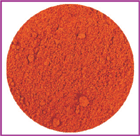
| Cayenne Pepper Powder |
|
|
Organic Red Cayenne pepper pack has finest quality organic pepper that you need to make a tasteful food. These high quality product is made from hand picked hot red Cayenne pepper that will give you the taste and aroma that a food lover needs. All our product packs have a re-sealing zipper to protect them from moisture and enhanced shelf life.
more |
|
|
|
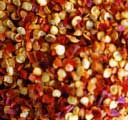
| Cayenne Pepper Flakes |
|
|
Organic Red Cayenne pepper pack has finest quality organic pepper that you need to make a tasteful food. These high quality product is made from hand picked hot red Cayenne pepper that will give you the taste and aroma that a food lover needs. All our product packs have a re-sealing zipper to protect them from moisture and enhanced shelf life.
more |
|
|
|
| Fennel Seeds |

|
|
Fennel (Foeniculum vulgare) is the most important species in the genus Foeniculum (treated as the sole species by many botanists), and is native to southern Europe (especially by the Mediterranean) and southwestern Asia. It is a member of the Apiaceae (formerly the Umbelliferae).
It is a highly aromatic perennial herb, erect, glaucous green, and grows to 2 m tall. The leaves grow up to 40 cm long; they are finely dissected, with the ultimate segments filiform, about 0.5 mm wide. The flowers are produced in terminal compound umbels 5—15 cm wide, each umbel section with 20—50 tiny yellow flowers on short pedicels. The fruit is a dry seed from 4—9 mm long, half as wide or less, and grooved.
Fennel is used as a food plant by t...
more |
|
|
|
| Foeniculum vulgare |
|
|
|
Fennel (Foeniculum vulgare) is the most important species in the genus Foeniculum (treated as the sole species by many botanists), and is native to southern Europe (especially by the Mediterranean) and southwestern Asia. It is a member of the Apiaceae (formerly the Umbelliferae).
It is a highly aromatic perennial herb, erect, glaucous green, and grows to 2 m tall. The leaves grow up to 40 cm long; they are finely dissected, with the ultimate segments filiform, about 0.5 mm wide. The flowers are produced in terminal compound umbels 5—15 cm wide, each umbel section with 20—50 tiny yellow flowers on short pedicels. The fruit is a dry seed from 4—9 mm long, half as wide or less, and grooved.
Fennel is used as a food plant by t...
more |
|
|
|
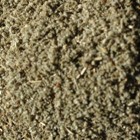
| Marjoram Whole |
|
|
(Origanum majorana, Lamiaceae) is a cold-sensitive perennial herb or
undershrub with sweet pine and citrus flavors. It is also called Sweet
Marjoram or Knotted Marjoram and Majorana hortensis.
The name marjoram (Old French majorane, Medieval Latin majorana) is not connected with the word major.
Marjoram is cultivated for its aromatic leaves, either green or dry,
for culinary purposes; the tops are cut as the plants begin to flower and
are dried slowly in the shade. It is often used in herb combinations
such as Herbes de Provence and Za'atar.
more |
|
|
|
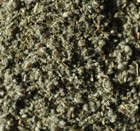
| Sage Rubbed |
|
|
Common sage (Salvia officinalis) is a small evergreen subshrub, with woody stems, grayish leaves, and blue to purplish flowers native to southern Europe and the Mediterranean region. It is much cultivated as a kitchen and medicinal herb, and is also called Garden sage, Kitchen sage, and Dalmatian sage. In southern Europe related species are sometimes cultivated for the same purpose, and may be confused with the common sage. The uses and benefits ascribed to it are many and varied, and are often shared with related species. The commonest uses made of the common sage include;
Teas and infusio...
more |
|
|
|
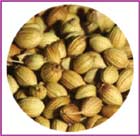
| Coriandrum sativum |
|
|
Coriander (Coriandrum sativum), also commonly called cilantro in North America, is an annual herb in the family Apiaceae. Coriander is native to southwestern Asia west to north Africa. It is a soft, hairless, foetid plant growing to 50 cm tall. The leaves are variable in shape, broadly lobed at the base of the plant, and slender and feathery higher on the flowering stems. The flowers are borne in small umbels, white or very pale pink, asymmetrical, with the petals pointing away from the center of the umbel longer (5-6 mm) than those pointing to the middle of the umbel (only 1-3 mm long). The fruit is a globular dry schizo carp 3-5 mm diameter.
All parts of the plant are edible, but the fresh leaves and the dried seeds are the most commonly used in cooking. Coriander is commonly used in Middle Eastern, Mediterranean, South Asian, Latin American, Chinese, African and Southeast Asian cuisine.
The leaves are variously referred to as coriander leaves, cilantro (in the United States, from the Spanish name for the plant), dhania (in th...
more |
|
|
|
| Cinnamomum verum Powder |
|
|
(Cinnamomum verum, synonym C. zeylanicum) is native to Sri Lanka and Southern India. The bark and powder is widely used as a spice. The leaves are ovate-oblong in shape, 7-18 cm long. The flowers, which are arranged in panicles, have a greenish color and a rather disagreeable odor. The fruit is a purple one-centimetre berry containing a single seed. Cinnamon has flavor due to an aromatic essential oil which it contains to the extent of from 0.5 to 1%. This oil is prepared by roughly pounding the bark, macerating it in sea-water, and then quickly distilling the whole. It is of a golden-yellow color, with the characteristic odor of cinnamon and a very hot aromatic taste. The pungent taste and scent come from cinnamic aldehyde or cinnamaldehyde and, by the absorption of oxygen as it ages, it darkens in colour and develops resinous compounds. Chemical components of the essential oil include ethyl cinnamate, eugenol, cinnamaldehyde, beta-caryophyllene, linalool and methyl chavicol. We offer Cinnamon in bark, sticks and powder forms. We ...
more |
|
|
|
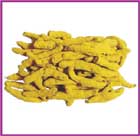
| Curcuma longa |
|
|
Turmeric, with its brilliant yellow color, has been used as a dye, medicine, and flavoring since 600 BC. Turmeric is a necessary ingredient of curry powder. It is extremely difficult to make fresh turmeric powder or paste, as it is extremely hard to grind. Turmeric powder should be kept in an airtight container and stored in a cool dry place.
Organic Turmeric powder can be used for encapsulation and preparing highly beneficial organic Turmeric health tablets. Organic Turmeric pastes and ointments can be made from Turmeric. Turmeric oil (obtained from Turmeric) is an effective mosquito repellant and compares favorably with dimethyl phthalate in its repellant action against mosquitoes. Turmeric powder is an essential ingredient in various Indian food preparations for taste and coloring and is an essential ingredient in various herbal preparations. Turmeric powder, extracts and curcumin also exhibit antioxidant property. Turmeric's major constituents are 'curcumin', various '...
more |
|
|
|
| Basil |
|
|
Basil (Ocimum basilicum) of the Family Lamiaceae, is a tender low-growing herb.
Basil is a culinary herb prominently featured in Italian cuisine, and also plays a major role in the Southeast Asian cuisines of Thailand, Vietnam and Laos. The plant tastes somewhat like anise, with a strong, pungent, sweet smell.
There are many varieties of basil. That which is used in Italian food is typically called sweet basil, as opposed to Thai basil, lemon basil and holy basil, which are used in Asia.
Basil is commonly used fresh in cooked recipes. It is generally added at the last moment, as cooking quickly destroys the flavour. The fresh herb can be kept for a short time in plastic bags in the refrigerator, or for a longer period in the freezer, after being blanched quickly in boiling water. The dried herb also loses most of its flavor after storage for long time just like other herbs.
more |
|
|
|
| Anethum graveolens |
|
|
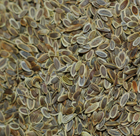
Dill (Anethum graveolens) is a short-lived annual herb. It is the sole species of the genus Anethum, though classified by some botanists in a related genus as Peucedanum graveolens (L.) C.B.Clarke. Its seeds, dill seed are used as a spice, and its fresh leaves, dill, and its dried leaves, dill weed, are used as herbs.
more |
|
|
|
| Cinnamomum verum Sticks (4 inch) |

|
|
(Cinnamomum verum, synonym C. zeylanicum) is native to Sri Lanka and Southern India. The bark and powder is widely used as a spice. The leaves are ovate-oblong in shape, 7-18 cm long. The flowers, which are arranged in panicles, have a greenish colur and a rather disagreeable odor. The fruit is a purple 1 cm berry containing a single seed. Cinnamon has flavor due to an aromatic essential oil which it contains to the extent of from 0.5 to 1%. This oil is prepared by roughly pounding the bark, macerating it in sea-water, and then quickly distilling the whole. It is of a golden-yellow color, with the characteristic odor of cinnamon and a very hot aromatic taste. The pungent taste and scent come from cinnamic aldehyde or cinnamaldehyde and, by the absorption of oxygen as it ages, it darkens in color and develops resinous compounds. Chemical components of the essential oil include ethyl cinnamate, eugenol, cinnamaldehyde, beta-caryophyllene, linalool and methyl chavicol. We offer Cinnamon in bark, sticks and powder forms. We don't offer...
more |
|
|
|
| Bay Leaf Turkish |
|
|
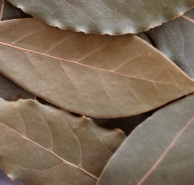
Bay leaf (plural bay leaves) refers to the aromatic leaf of the bay laurel (Laurus nobilis, Lauraceae). Fresh or dried bay leaves are used in cooking for their distinctive flavor and fragrance. The leaves are often used to flavor soups, stews, braises and pâtés in Mediterranean cuisine.
If eaten whole, bay leaves are pungent and have a sharp, bitter taste. As with many spices and flavorings, the fragrance of the bay leaf is more noticeable than its taste. When dried, the fragrance is herbal, slightly floral, and somewhat similar to oregano and thyme. Myrcene, which is a component of many essential oils used in perfumery, can be extracted from the bay leaf.
more |
|
|
|
| Dill Seed |
|
|
|
Dill (Anethum graveolens) is a short-lived annual herb. It is the sole species of the genus Anethum, though classified by some botanists in a related genus as Peucedanum graveolens (L.) C.B.Clarke. Its seeds, dill seed are used as a spice, and its fresh leaves, dill, and its dried leaves, dill weed, are used as herbs.
more |
|
|
|
|
<< < 6 7 8 9 [10] > >> |
|
|
|
|













)
)
)
)
)
)
)
)
)
)
)
)

 RSS Feed