|
| Welcome! |
|
Indus Organics provides certified organic products for retail and bulk wholesale. Our current products are fine organic culinary herbs, organic spices and organic seeds. Our retail package products are... ... more
|
|
|
|
 |
Order Products |
|
 |
|
|
|
Other Links |
|
|
|
|
|
News Letter |
|
|
|
|
 |
Latest News |
|
|
|
|
|
|
|
Browse By Product Name : A B C D F G H M N O P R S T W Z
|
| Tamarind |
|
|
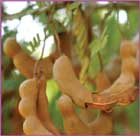
Tamarindus indica is the only species of the genus Tamarindus in the family Fabaceae. The tree can grow up to 20 meters in height, and stays evergreen in regions without a dry season. Tamarind timber consists of hard, dark red heartwood and softer, yellowish sapwood. The leaves consist of 10 to 40 leaflets. The flowers are produced in racemes. The tree produces brown pod-like fruits, which contain pulp and many hard-coated seeds. The seeds can be scarified to enhance germination.
In Malaysia it is called asam in Malay and swee boey in Hokkien. In India its called imlee. In Sinhala the name is siyambala, in Telugu it is called Chintachettu (tree) and Chintapandu (fruit extract) and in Tamil and Malayalam it is puli. The tamarind is the provincial tree of the Phetchabun province of Tha...
more |
|
|
|
| Thyme Whole |
|
|
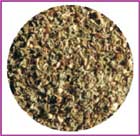
(Thymus) is a genus of about 350 species of aromatic perennial herbs and sub-shrubs to 40 cm tall, in the Family Lamiaceae and native to Europe, North Africa and Asia. A number of species hassome chemotypes. The stems tend to be narrow or even wiry; the leaves are evergreen in most species, arranged in opposite pairs, oval, entire, and small, 4-20 mm long. The flowers are in dense terminal heads, with an uneven calyx, with the upper lip three-lobed, and the lower cleft; the corolla is tubular, 4-10 mm long, and white, pink or purple. Common Thyme or Garden Thyme, T. vulgaris is a commonly used culinary herb. It is a Mediterranean perennial which is best suited to well-drained soils and enjoys full sun.Citrus Thyme T. x citriodorus (T. pulegioides x T. vulgaris) is also a popular culinary herb, with cultivars selected with flavours of various C...
more |
|
|
|
| Turmeric Powder |

|
|
Turmeric, with its brilliant yellow color, has been used as a dye, medicine, and flavoring since 600 BC. Turmeric is a necessary ingredient of curry powder. It is extremely difficult to make fresh turmeric powder or paste, as it is extremely hard to grind. Turmeric powder should be kept in an airtight container and stored in a cool dry place. Curcumin, one of the active ingredients in turmeric, induces the flow of bile, which breaks down fats. Curcumin is also an anti-inflammatory agent that relieves the aches and pains associated with arthritis. It can be taken on a daily basis to improve body immunity to various allergic conditions owing to its anti-Bacterial activities. Turmeric's volatile oil functions as an external antibiotic, preventing bacterial infection in wounds.
Organic Turmeric powder can be used for encapsulation and preparing highly beneficial organic Turmeric health tablets. Organic Turmeric pastes and ointments can be made from Turmeric. The turmeric, wi...
more |
|
|
|
| Trigonella foenum-graecum powder |

|
|
Fenugreek, is a crop plant grown as a potherb and for the spice made from its seeds. The fenugreek plant grows wild from the eastern Mediterranean area to China; it is cultivated worldwide. The name fenugreek or foenum-graecum is from Latin for "Greek hay".
Fenugreek is used both as a herb (the leaves) and as a spice (the seed). The yellow, rhombic fenugreek seed is frequently used in the preparation of pickles, curry powders and pastes, and is often encountered in the cuisine of the Indian subcontinent and Thailand. The young leaves and sprouts of fenugreek are eaten as greens and the fresh or dried leaves are used to flavor other dishes. In the Arabian nation of Yemen it is the main condiment and an ingredient added to the national dish called Saltah. The similarity in th...
more |
|
|
|
| True Ceylon Cinnamon Powder (Bulk can be purchased at online store) |
|
|
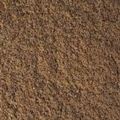
(Cinnamomum verum, synonym C. zeylanicum) is native to Sri Lanka and Southern India. The bark and powder is widely used as a spice. The leaves are ovate-oblong in shape, 7-18 cm long. The flowers, which are arranged in panicles, have a greenish color and a rather disagreeable odor. The fruit is a purple one-centimetre berry containing a single seed. Cinnamon has flavor due to an aromatic essential oil which it contains to the extent of from 0.5 to 1%. This oil is prepared by roughly pounding the bark, macerating it in sea-water, and then quickly distilling the whole. It is of a golden-yellow color, with the characteristic odor of cinnamon and a very hot aromatic taste. The pungent taste and scent come from cinnamic aldehyde or cinnamaldehyde and, by the absorption of oxygen as it ages, it darkens in colour and develops resinous compounds. Chemical components of the essential oil include ethyl cinnamate, eugenol, cinnamaldehyde, beta-caryophyllene, linalool and methyl chavicol. We offer Cinnamon in bark, sticks and powder forms. We ...
more |
|
|
|
| True Cinnamon Powder (Bulk can be purchased at online store) |
|
|
|
(Cinnamomum verum, synonym C. zeylanicum) is native to Sri Lanka and Southern India. The bark and powder is widely used as a spice. It is of a golden-yellow color, with the characteristic odor of cinnamon and a very hot aromatic taste. The pungent taste and scent come from cinnamic aldehyde or cinnamaldehyde and, by the absorption of oxygen as it ages, it darkens in color and develops resinous compounds. Chemical components of the essential oil include ethyl cinnamate, eugenol, cinnamaldehyde, beta-caryophyllene, linalool and methyl chavicol. We offer Ceylon Cinnamon in bark, sticks and powder forms. We don't offer Cassia.
The name cinnamon is correctly used to refer to Ceylon Cinnamon, also known as "true cinnamon" (from the botanical name C. verum). However, the related species Cassia(Cinnamomum aromaticum) is sometimes sold labeled as cinnamon, distinguished from true cinnamon as "Indonesian cinnamon". True cinnamon, using only the thin inner bark, has a finer, less dense and more crumbly texture, and is co...
more |
|
|
|
|
<< < [1] > >> |
|
|
|
|













)
)
)
)
)

 RSS Feed