|
|
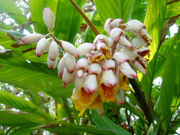
Ginger root is used extensively as a spice in many if not most cuisines of the world. Though called a root, it is actually the rhizome of the monocotyledonous perennial plant Zingiber officinale. Ginger contains upt to 3% of an essential oil which causes the fragrance of the spice. The main constituents are sesquiterpenoids with zingiberene as the main component. Lesser amounts of other sesquiterpenoids (β-sesquiphellandrene, bisabolene and farnesene) and a small monoterpenoid fraction (β-phelladrene, cineol, and citral) have also been identified.
The pungent taste of ginger is due to nonvolatile phenylpropanoids (particularly gingerol and zingerone) and diarylheptanoids (gingeroles and shoagoles); the latter are more pungent and form from the former when ginger is dried. Cooking ginger transforms gingerol into zingerone, which is less pungent and has a spicy-sweet aroma. None of these pungent chemicals are related to capsaicin, the principal hot constituent of chile pepper.
Young ginger roots are juicy and fleshy with a very mild taste. They are often pickled in vinegar or sherry as a snack or just cooked as an ingredient in many dishes. Mature ginger roots are fibrous and nearly dry. The juice from old ginger roots is extremely potent and is often used as a spice in Chinese cuisine to cover up other strong odors and flavors such as in seafood and mutton.
Ginger is also made into candy, is used as a flavoring for cookies, crackers and cake, and is the main flavor in ginger ale, a sweet, carbonated, non-alcoholic beverage, as well as the similar, but somewhat spicier beverage ginger beer. A ginger-flavored liqueur called Canton is produced in the Guangdong province of China; it is advertised to be based on a recipe created for the rulers of the Qing Dynasty and made from six different varieties of ginger. Green ginger wine is produced in the United Kingdom traditionally Crabbie's and Stone's, in a green glass bottle. Ginger is also used as a spice added to hot coffee.
In Japan, ginger is pickled to make beni shoga and gari or grated and used raw on tofu or noodles. In Western cuisine, ginger is traditionally restricted to sweet foods, such as ginger ale, gingerbread, ginger snaps (a type of cookie), ginger cake and ginger biscuits.
Powdered dry ginger (ground ginger) is typically to add spiciness to gingerbread and other recipes. Ground and fresh ginger taste quite different and ground ginger is a particularly poor substitute for fresh ginger. Fresh ginger can be successfully substituted for ground ginger and should be done at a ratio of 6 parts fresh for 1 part ground. You generally achieve better results by substituting only half the ground ginger for fresh ginger.
In Myanmar, ginger is used in a salad dish called gyin-tho, which consists of shredded ginger preserved in oil, and a variety of nuts and seeds. Ginger has a sialagogue action, stimulating the production of saliva. Medical research has shown that ginger root is an effective treatment for nausea caused by motion sickness or other illness. Although very effective against all forms of nausea, PDR health officials do not recommend taking ginger root for morning sickness commonly associated with pregnancy. Ginger root also contains many antioxidants. Powdered dried ginger root is made into pills for medicinal use. Chinese women traditionally eat ginger root during pregnancy to combat morning sickness. Ginger ale and ginger beer have been recommended as "stomach settlers" for generations in countries where the beverages are made. Ginger water was commonly used to avoid heat cramps in the United States in the past.
In addition to providing relief from nausea and vomiting, ginger extract has long been used in traditional medical practices to decrease inflammation. In fact, many herbalists today use ginger to help treat health problems associated with inflammation, such as arthritis, bronchitis, and ulcerative colitis. In a recent study of 261 people with osteoarthritis (OA) of the knee, those who received a ginger extract twice daily experienced less pain and required fewer pain-killing medications compared to those who received placebo. Although there have also been a few other studies of the benefit of ginger for arthritis, one recent trial found that the herb was no more effective than ibuprofen (a medication frequently used to treat OA) or placebo in reducing symptoms of OA.
Although it is much too early to tell if this will benefit those with heart disease, a few preliminary studies suggest that ginger may lower cholesterol and prevent the blood from clotting. Each of these effects may protect the blood vessels from blockage and the damaging effects of blockage such as atherosclerosis, which can lead to a heart attack or stroke. Again, however, it is too early too know if these initial study results will ultimately prove beneficial. More research is necessary. The chacteristic odor and flavor of ginger root is caused by a mixture of zingerone, shoagoles and gingerols, volatile oils that compose about 1%�3% by weight of fresh ginger. The gingerols have analgesic, sedative, antipyretic, antibacterial, and GI tract motility effects.
|












)




)