|
| Welcome! |
|
Organic is not a simple replacement of synthetic fertilizers and pesticides with organic inputs and biologically active formulations, but it envisages a comprehe... ... more
|
|
|
|
 |
Order Products |
|
|
|
|
|
Usage Search |
|
|
|
|
|
Other Links |
|
|
|
|
 |
Latest News |
|
|
| Oct 21, 2007 |
|
Indus Organics launches Beta Version of Medical usage search for herbs & spices
Indus Organic launches beta version of medical usage search using latest software technolgies to educate customers. Search tool educates customer about the medical usage of spices and herbs. Indus is the first company to launch the software in the world.
Indus Organics launches Retail Brand at Allthings Organic Show
Indus Organic launches retail brand of organic Malabar Herbs and Spices at All Things Organic show (May 5-8) at McCormick Place in Chicago. Come and see our new product range at booth #453
|

|
|
 |
| January 1, 2007 |
|
Indus Organics Launches Saving the Community Program
Indus Organics has launched a giving back to community program to support the farmer education, organic farming, child education and saving the earth program. Company will donate part of the profits from the sale of organic spices, herbs and tea products. |
|
|
|
|
|
|
|
| Cilantro Cut & Sifted |
|
|
|
The leaves are variously referred to as coriander leaves, cilantro (in the United States, from the Spanish name for the plant), dhania (in the Indian subcontinent, and increasingly, in Britain), Chinese parsley or Mexican parsley. The leaves have a very different taste from the seeds, similar to parsley but "juicier" and with citrus-like overtones. Some people instead perceive an unpleasant "soapy" taste and/or a rank smell. This taste is believed to be a genetic trait, but has yet to be fully researched.
The fresh leaves are an essential ingredient in many Vietnamese foods, Asian chutneys and Mexican salsas and guacamole. Chopped coriander leaves are also used as a garnish on cooked dishes such as dal and many curries. As heat diminishes their flavour quickly, coriander leaves are often used raw or added to the dish right before serving. (Though in some Indian and Central Asian recipes, coriander leaves are used in huge amounts and cooked till they dissolve into sauce and their flavour mellows.
Coriander leaves were formerly common in European cuisine but nearly disappeared before the modern period. Today Europeans usually eat coriander leaves only in dishes that originated from foreign cuisines, except in some regions of Portugal, particularly Alentejo where it is still an essential ingredient in many traditional dishes.
The fresh coriander herb is best stored in the refrigerator in airtight containers, after chopping off the roots. The leaves do not keep well and should be eaten quickly, as they lose their aroma when dried or frozen.
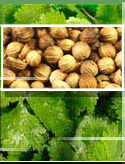
The dry fruits are known as coriander seeds. In some regions, the use of the word coriander in food preparation always refers to these seeds (as a spice), rather than to the plant itself. The seeds have a lemony citrus flavour when crushed, due to the presence of the terpenes linalool and pinene. It is also described as warm, nutty, spicy, and orange-flavoured. They are usually dried but can be eaten green.
If the spice is bought (or picked -- it can be grown in a home garden) whole in a non-dried form, it can be dried in the sun. Most commonly, it is bought as whole dried seeds, but can also be purchased in ground form. When grinding at home, it can be roasted or heated on a dry pan briefly to enhance the aroma before grinding it in an electric grinder or with a mortar and pestle; ground coriander seeds lose their flavour quickly in storage and are best only ground as needed. For optimum flavour, whole coriander seed should be used within six months, or stored for no more than a year in a tightly sealed container away from sunlight and heat.
Coriander seed is a key spice in garam masala and Indian curries, which often employ the ground fruits in generous amounts together with cumin.
Outside of Asia, coriander seed is an important spice for sausages in Germany and South Africa. In Russia and Central Europe coriander seed is an occasional ingredient in rye bread as an alternative to caraway. Apart from the uses just noted, coriander seeds are rarely used in European cuisine today, though they were more important in former centuries.
Coriander seeds are also used in brewing certain styles of beer, particularly some Belgian wheat beers. The coriander seeds are typically used in conjunction with orange peel to add a citrus character to these styles of beer.
Coriander seed is also used in Ethiopian and Arabic cooking.
Coriander roots are used in a variety of oriental cuisine. They are commonly used in Thai dishes.
|
|
|
|
Usage:
Researchers have found that coriander can assist with clearing the body of lead, aluminum, and mercury.
Coriander has been used as a folk medicine for the relief of anxiety and insomnia in Iranian folk medicine. Experiments in mice support its use as an anxiolytic.
Coriander essential oil has been demonstrated to exhibit antibacterial action against E. Coli. All parts of the plant are edible, but the fresh leaves and the dried seeds are the most commonly used in cooking. Coriander is commonly used in Middle Eastern, Mediterranean, South Asian, Latin American, Chinese, African and Southeast Asian cuisine.
Coriander (Coriandrum sativum), also commonly called cilantro in North America, is an annual herb in the family Apiaceae. Coriander is native to southwestern Asia west to north Africa. It is a soft, hairless, foetid plant growing to 50 cm tall. The leaves are variable in shape, broadly lobed at the base of the plant, and slender and feathery higher on the flowering stems. The flowers are borne in small umbels, white or very pale pink, asymmetrical, with the petals pointing away from the centre of the umbel longer (5-6 mm) than those pointing to the middle of the umbel (only 1-3 mm long). The fruit is a globular dry schizocarp 3-5 mm diameter. |
|
|
|
|
|
|
|